

Seeing Yambaru, One Plant at a Time
Shin Ota — Founder, Mille Plateaux
When I returned to Yambaru after twenty-five years, I felt that much of the landscape had changed.
The plants looked different.
Unfamiliar greenery caught my eye, and places I thought I knew no longer looked quite the same.
But the changes went beyond vegetation.
I noticed more buildings that were no longer in use. There seemed to be fewer people, fewer children. Looking toward the sea, I felt that some of the marine life I once remembered seeing had become less common.
The Yambaru I remembered and the Yambaru before me were not quite the same.
Twenty-five years had passed between those two landscapes.

Nature changes. Communities change.
Not every change can be explained by a single cause.
Yet what stayed with me was more than nostalgia.
What had shaped this place?
What had created the landscapes I had always found beautiful?
And was there a way to carry something of their memory into the future?
As I continued to reflect on these questions, my attention turned toward the individual plants that make up a landscape.
The Landscape Within a Plant
From a distance, a forest appears as a continuous expanse of green.
Trees, ferns, vines and grasses merge into a larger whole.
Yet within that greenery are countless individual plants.
A leaf unfolding from a stem. The architecture of a fern. The thickness and curvature of a tropical plant. The distinctive form of each botanical structure.
Every plant has its own appearance, its own growth and its own relationships with the surrounding environment and other living beings.
What we recognize as a landscape is shaped by these countless individual lives and their connections.
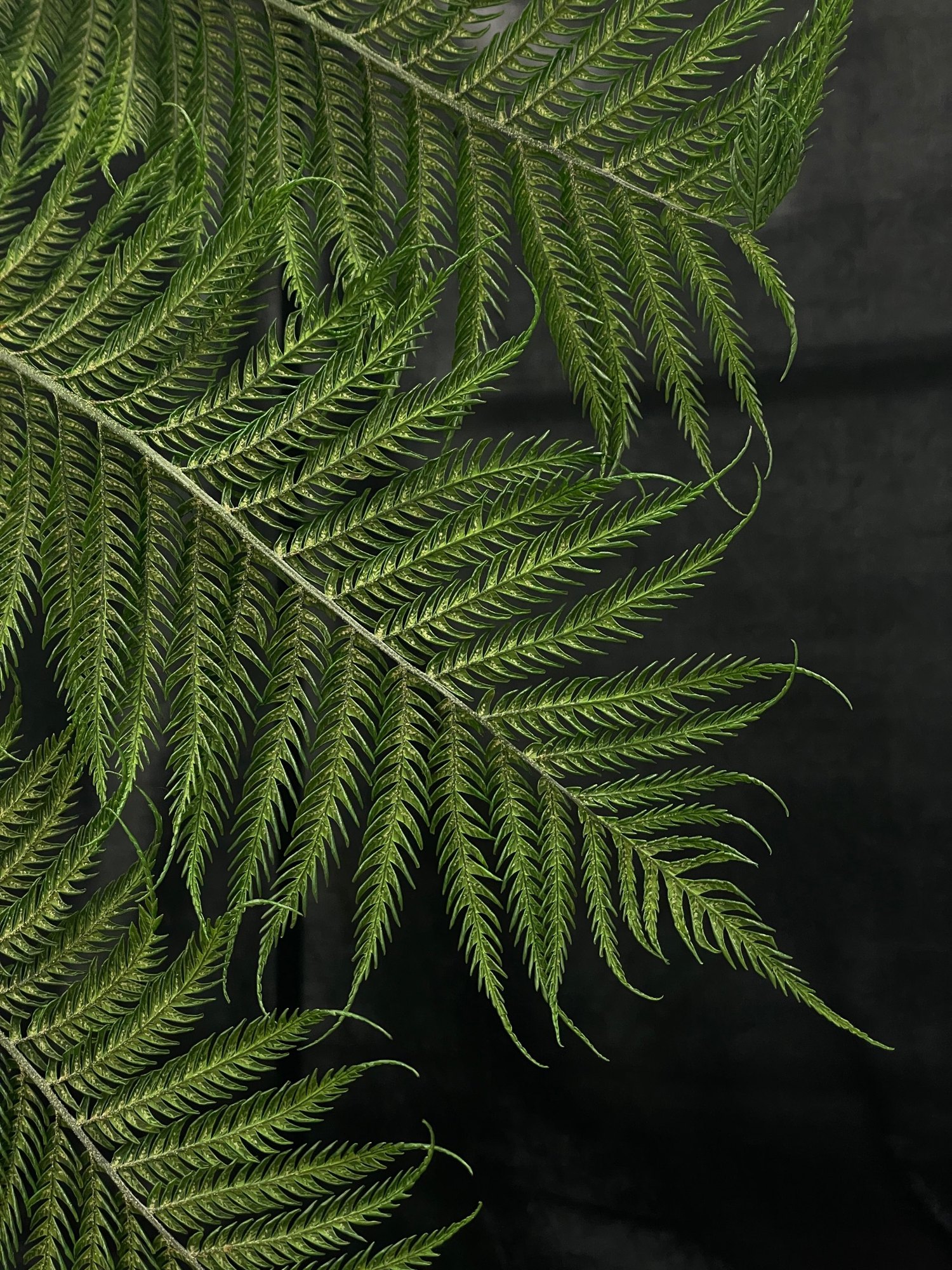
I wanted to look more closely at each of them.
To observe a single plant is not to turn away from the forest.
It is another way of beginning to understand it.
The Challenge of Preservation
I wanted to retain something of these botanical forms.
That desire gradually led me toward the exploration of preservation techniques.
Conventional preservation methods are not equally suited to every plant. Certain tropical green plants, particularly those with thick or moisture-rich structures, present particular challenges.
Those difficulties became a starting point for research.
Observing plants, conducting trials and exploring processing methods.
Working with the different structures and characteristics of each botanical form, I continued to investigate how plants that had been difficult to preserve might retain something of their original appearance.
The questions were technical, but their motivation went beyond technology.
If the distinctive form of a plant could remain present beyond its period of living growth, what might we discover by looking at it?
A preserved botanical form can invite us to notice details that might otherwise be overlooked.
It offers an opportunity to encounter a plant not simply as part of a green background, but as an individual presence.
Preservation does not make a plant timeless. Natural materials may continue to change, and no process can reproduce the living relationships of an ecosystem.
Still, I believe preservation can offer another way of observing, remembering and learning from plants.
From a Surface to a Point
When we look at a landscape, we often recognize the whole before we notice its parts.
A hillside becomes a green slope. A forest becomes a canopy. Roadside vegetation becomes a continuous mass of greenery.
But what happens when we begin to recognize the individual plants within that view?
The surface becomes a collection of distinct forms.
A fern is no longer simply greenery.
A vine is no longer merely part of the undergrowth.
Each plant becomes something we can observe, identify, question and understand.
From a landscape perceived as a continuous surface to the individuality of a single plant.
This shift in perspective lies at the heart of Mille Plateaux.
And it does not end with the individual.
Once we begin to recognize plants separately, we can also begin to see their connections.
The environments they inhabit. The organisms around them. The conditions that shape their lives.
From landscape to plant.
From plant to relationship.
And from relationship, back to a deeper understanding of the landscape.
I hope our work can create opportunities for this cycle of discovery.
Carrying Memory Forward
Preserving a botanical form is not the same as protecting a living ecosystem.
A preserved plant cannot replace a living forest, nor can a single object resolve the environmental challenges facing Yambaru or other parts of the world.
That distinction matters to us.
Mille Plateaux’s work begins with respect for the living world and an awareness that its conditions are changing.
Through research, making and creative expression, we explore ways to encourage greater attention, understanding and care for nature.
The botanical forms we preserve may become materials for design, objects within spaces or subjects of study.
But we hope they can also become invitations.
To notice a plant that might otherwise have gone unseen.
To ask where it grows and what surrounds it.
To consider the relationships that sustain a landscape.
And perhaps, through these small encounters, to feel a more personal connection to the living Earth.

A Shared Practice
Mille Plateaux began with my personal experience of change in Yambaru and the questions that followed.
But today, this exploration is no longer mine alone.
Botanical research and preservation development. Engineering solutions for manufacturing processes. The transfer of technical knowledge and the practice of production. Building relationships with people and businesses. Creating the organizational foundations that allow our work to continue.
People with different skills and experiences now contribute to the development of Mille Plateaux.
What began as a personal desire has grown into a shared commitment.
We do not have complete answers.
We continue to observe plants, conduct experiments and collaborate with others, learning from both the possibilities and limitations of botanical preservation.
Although our practice is rooted in Yambaru, the questions guiding us extend beyond any one place.
How do we recognize the beauty of what is changing?
How can scientific exploration and creative practice deepen our understanding of nature?
What can we carry forward, and what must remain alive in the world itself?
These are questions we intend to keep asking.
Preserving botanical forms is one way of carrying the memory of a landscape into the future.
Not as a substitute for nature.
But as another way of learning to see it.
Shin Ota
Founder, Mille Plateaux
Yambaru, Okinawa
